Description
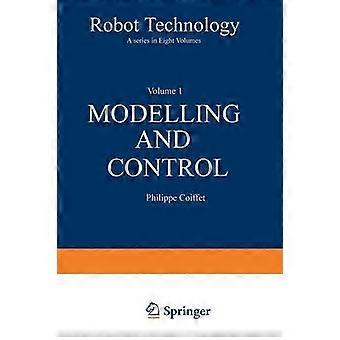
Modelling and Control
1 Definitions and objectives. - Origin of the word robot'. - Robotics today. - What is a robot?. - Classification of robots. - Conclusions. - 2 Structure and specification of articulated robots. - Degrees of freedom of a solid. - Degrees of freedom of a robot. - Position of the vehicle and resulting redundancy of degrees of freedom. - How many degrees of freedom?. - False degrees of freedom. - Architecture of the arm. - Description of articulated mechanical systems. - Conclusions. - 3 Articulated mechanical systems: determination of kinematic elements. - Computation of the orientation of a chain relative to a set bound to an upper segment. - Computation of the orientation of a chain relative to a set bound to a lower segment. - Computation of the position of a point on a chain in relation to an upper segment. - Computation of the position of a point on a chain in relation to a lower segment. - Determination of the velocity vectors of rotation of different segments of a chain relative to a set of coordinate axes. - Determination of the velocity vectors of translation of different segments of a chain relative to a set of coordinate axes. - Conclusions. - 4 Calculation of robot articulation variables. - The absence of a solution. - An infinite number of solutions. - A limited number of solutions. - Practical choice of [Pi(R0) Sj(R0)]. - Mechanisms with six degrees of freedom. - Mechanisms with more than six degrees of freedom. - Conclusions. - 5 Positional control of articulated robots. - Reference and starting configurations. - The principles of positional control. - Balanced and initialization configurations. - The problems associated with positional control. - 6 Speed control of articulated robots. - The principles of speed control. - Problems arising from the use of equation (6-16). - Methods ofresolving redundant systems. - Conclusions. - 7 Articulated mechanical systems: the dynamic model. - A dynamic model for an open articulated chain of rigid segments without backlash or friction. - Development of a dynamic equation for a system having three degrees of freedom. - Another type of model: the bond graph. - Difficulties with dynamic models. - A dynamic model of a belt drive. - Conclusions. - 8 Dynamic control of articulated robots. - Problems associated with real time and computation. - Simplification of the equation of the model. - Other methods of dynamic control. - The choice of the space used in computation. - Conclusions. - 9 Learning and trajectory generation. - Methods of recording trajectories. - Manual control used outside of training. - Improved controls. - Trajectory generation. - Conclusions. - 10 Tasks and performance of articulated robots. - Description of tasks. - The performance of articulated robots. - Conclusions. - References. Language: English
-
Identifiant Fruugo:
450594549-949696030
-
ISBN:
9781468468489
Livraison & retours
Expédition dans un délai de 4 jours
Expédition de Royaume-Uni.
Nous mettons tout en œuvre pour que les produits que vous commandez vous soient livrés dans leur intégralité et selon vos indications. Néanmoins, si vous recevez une commande incomplète, des articles différents de ceux commandés ou si, pour toute autre raison, la commande ne vous satisfait pas, vous pouvez retourner la commande ou tout produit inclus dans celle-ci et recevoir un remboursement complet des articles. Voir l'intégralité de la politique de retour